
News
FIFA 2020 Women’s world 11


Christiane Endler
The goalkeeper plays for Paris Saint-Germain and the Chile women’s national team.

Lucy Bronze
The right-back for English club Manchester City and the England

Wendie Renard
French professional footballer who plays as a central defender for Division 1 Féminine club Olympique Lyonnais, which she captains, and the France national team. A goal-scoring defender,

Millie Bright
English footballer who plays as a defender for Chelsea and the England national team. She previously played for Doncaster Belles, Leeds Ladies and represented England on the under-19 and under-23 national teams

Delphine Cascarino
French women’s association football player from Saint-Priest, Rhône. She currently plays for Olympique Lyonnais and the France women’s national football team as a midfielder.

Barbara Bonansea
Italian footballer who plays as a forward or midfielder for Serie A club Juventus and the Italy national team.

Verónica Boquete
Spanish footballer who plays as a forward or midfielder for Italian Serie A club AC Milan. As well as in her native Spain, she has played professionally for clubs in the United States, Russia, Sweden, France, Germany, China, and Italy

Megan Rapinoe
American professional soccer player who plays as a winger and captains OL Reign in the National Women’s Soccer League and the United States national team.

Pernille Harder
Danish professional footballer who plays as a forward for English FA Women’s Super League club Chelsea and the Danish national team. In September 2020, she became the world’s most expensive female footballer following her transfer from Wolfsburg to Chelsea

Vivianne Miedema
Dutch professional footballer who plays as a forward for FA Women’s Super League club Arsenal and the Netherlands national team. She previously played for Bayern Munich and SC Heerenveen

Tobin Heath
American professional soccer player for Manchester United of the English FA Women’s Super League, and the United States national team

Sri Lanka’s rising athletics star Rumesh Tharanga Pathiragae reinforced his status as one of the world’s premier javelin throwers by capturing gold at the prestigious Ostrava Golden Spike meeting in the Czech Republic on Tuesday.
The 23-year-old delivered another commanding performance at the World Athletics Continental Tour Gold event, producing a winning throw of 86.57 metres to finish comfortably ahead of a high-quality international field.
Rumesh signaled his intentions from the outset with an opening effort of 85.87m before improving to 86.30m in the second round. He then produced his best throw of the day, 86.57m, in the third round, a mark that remained unbeaten for the rest of the competition.
Grenada’s double world champion Anderson Peters had to settle for second place with 84.27m, while South Africa’s Douw Smit completed the podium with a throw of 83.90m.
The latest triumph comes just weeks after Rumesh announced himself on the global stage with a sensational 92.62m effort in Rome, a throw that elevated him to eighth place on the all-time world rankings and established him as a genuine contender for major international honours.
Unlike in Rome, where he arrived as an emerging talent, Rumesh entered the Ostrava meet carrying the weight of expectation. Widely regarded as the athlete to beat in men’s javelin this season, the Sri Lankan was among the headline attractions of the competition and featured prominently in pre-event promotions.
Minister of Sports Sunil Kumara Gamage has announced that disciplinary action will be taken against the Sri Lanka Rugby Federation following the national team’s failure to obtain visas for its scheduled Asian Rugby Championship match against South Korea, resulting in the cancellation of the fixture last week.
Addressing reporters, the Minister emphasized that the responsibility for securing travel documents and making logistical arrangements rests entirely with the relevant sports federation and not with the Ministry of Sports.
Gamage stated that federations are expected to make visa applications and travel arrangements well in advance and cannot rely on last-minute interventions. He described the incident as a clear case of negligence on the part of the Rugby Federation.
“The Sports Ministry does not intervene in visa or ticket processes. If funding is provided, we cover expenses, but team selection and visa arrangements are solely the federation’s responsibility. The Federation cannot request a visa on Monday if the team is to travel on Wednesday. This is the Federation’s negligence. This is not a government issue; it is an issue of the Federation or Association. We will take disciplinary action, as we have done before,” the Minister said.
He further stressed that such administrative failures cannot be allowed to continue, noting that sports federations often attempt to shift responsibility to the Ministry when shortcomings arise.
The Minister reiterated that the Rugby Federation must be held accountable for the cancellation of the international fixture, adding that the matter has also attracted attention in Parliament.
The cancellation of the Asian Rugby Championship match has raised concerns over the management and administrative efficiency of the sport’s governing body, with calls for greater accountability to prevent similar incidents in the future.
Sri Lanka A player Vishen Halambage has reportedly become the latest victim of online harassment after a match-related confrontation with India A batter Vaibhav Suryavanshi sparked widespread discussion on social media.
The incident occurred during Sri Lanka A’s dramatic Super Over triumph over India A in the Tri-Nation Series on Monday. Footage showing a tense exchange between the two young cricketers quickly spread across social media platforms, drawing significant attention from cricket fans.
Following the match, Halambage’s Instagram account was flooded with critical and abusive messages, with many comments reportedly originating from social media users reacting to the on-field altercation. Unverified reports also suggested that individuals connected to the player were subjected to online harassment.
By Tuesday, Halambage’s Instagram profile appeared to be inaccessible. While some reports indicated that the account may have been blocked or restricted after receiving numerous complaints, the exact reason remains unclear. Neither the player nor Instagram has publicly commented on the matter.
The episode has once again brought attention to the growing issue of online abuse in sport, where athletes particularly younger players can face intense backlash following high-profile incidents. Sports analysts and observers have repeatedly called for greater efforts to curb harassment on digital platforms and promote responsible fan engagement.
The match itself ended in a memorable victory for Sri Lanka A, but the events that followed have shifted attention toward the challenges athletes face beyond the boundary ropes.

Rumesh Extends European Dominance with Ostrava Gold

Sports Minister Warns Rugby Federation of Disciplinary Action Over Visa Fiasco

Online Abuse Targets Sri Lanka A Cricketer After Match Incident

Sri Lanka Schools National Championship 2025: Super 8 Fixtures and Grouping

2025 Schools Rugby Season Set to Thrill Fans with Knockout and League Action

Sri Lanka’s Greatest Cricketers: Top Batters and Bowlers of All Time

The Future of Sri Lankan Rugby | Pavithra Fernando Interview | Game Plan | Episode 1 Part II

RUGBY PRESIDENT PAVITHRA FERNANDO SPEAKS OUT! | Game Plan | Episode 01

Sri Lanka’s Strongest Man? 💪 | Ransiru Jayathilake | Date With Sporty | Ep 7
-
 Football1 year ago
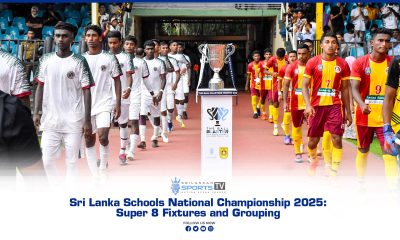
Sri Lanka Schools National Championship 2025: Super 8 Fixtures and Grouping
-
 News1 year ago
2025 Schools Rugby Season Set to Thrill Fans with Knockout and League Action
-
 Cricket1 year ago
Sri Lanka’s Greatest Cricketers: Top Batters and Bowlers of All Time
-
 Cricket1 year ago
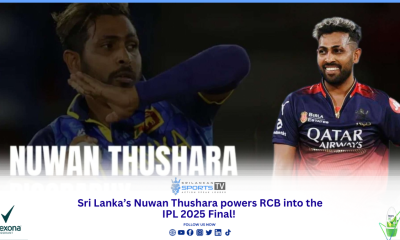
Nuwan Thushara Shines as RCB Storms into IPL 2025 Final
-
 Live5 years ago
Live Broadcast of Syria vs Sri Lanka | AFC U23 Asian Championship Qualification
-
 News1 year ago
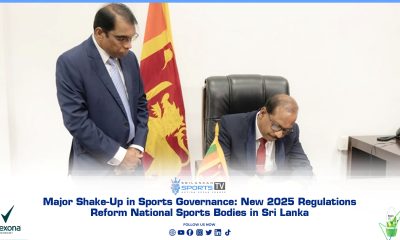
Major Shake-Up in Sports Governance: New 2025 Regulations Reform National Sports Bodies in Sri Lanka
-
 Football1 year ago
FFSL Rebrands Division-1 as ‘League-One’ with a Bold New Vision
-
 Football1 year ago
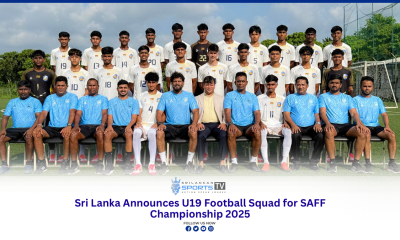
Sri Lanka Announces U19 Football Squad for SAFF Championship 2025