
News
Revisiting the 2019 World Cup and the league format

The ICC Men’s Cricket World Cup 2023 will follow the same format as the previous edition four years ago, meaning that all 10 teams will face one another.
With a new format set to be introduced in 2027, this will be the final go-around for the 10-team Group Stage which provides 45 entertaining encounters to decide on four semi-finalists.
In 2019, that began with a thrilling clash between England and South Africa at The Oval – the home side getting off to a winning start on their way to a maiden ICC Men’s Cricket World Cup victory.
With every team playing nine matches, the Group Stage lasted six weeks, with ebbs and flows as new contenders emerged.
The beauty of the format meant that a slow start was not necessarily fatal to a team’s chances of progressing.
In 2019, for example, Pakistan started very slowly, winning just one of their opening five matches – earning a 14-run success over eventual champions England at Trent Bridge.
Despite that, Pakistan finished with four successive victories to get to within a whisker of qualification, missing out on the semi-finals on net run-rate.
They finished level on points with runners-up New Zealand and just one point behind England as momentum almost carried them into the semi-finals as the form side.
At the other end of the spectrum, Australia were the first team to clinch a place in the last four, winning six of their first seven matches, the only exception a defeat to India.
India were the next team to book their semi-final spot, beating Bangladesh on their way to leading the Group Stage with seven wins from nine matches.
However, the World Cup is as much about timing your run as being fast starters, and it was the hosts and the Kiwis who found their best form come semi-final time.
With every team having had their chance to take on the world’s best, the knock-out stages were all about peaking on the day.
First up were India and New Zealand, who faced off over two days at Old Trafford as the weather played its part in proceedings.
It went down to the wire, but some stunning fielding from Martin Guptill to remove MS Dhoni in the penultimate over helped the Black Caps to an 18-run victory.
The following day, England were rather more emphatic in avenging their Group Stage loss to Australia, powering to an eight-wicket win to earn a place in the final for the first time since 1992.
Those results meant that the final would crown a new champion for the first time in more than two decades since Sri Lanka had claimed victory as one of the hosts in 1996.
England went onto emulate the Sri Lankans, famously doing so in the most dramatic circumstances at Lord’s.
New Zealand made 241 for eight batting first, before England matched that total, bowled out for 241 in reply to set up a Super Over.
Again, the teams matched each other blow for blow in the Super Over, each scoring 15 runs, as England were crowned champions on boundaries scored.
Victors in the first game, champions in the last, England showed just how to manage this Cricket World Cup format on their way to lifting the trophy.
The question now is, will they be able to repeat the feat or will someone else prove to be the masters of the 10-team Group Stage set-up?

24 Schools, 15 Venues and Three National Trophies as Ball Blaster Enters Its Third Year
COLOMBO — Ball Blaster, Sri Lanka’s premier school football tournament, is set to return in 2026 with its biggest edition yet, organized by Aasgard Sports (Private) Limited in collaboration with the Sri Lanka Schools Football Association and the Ministry of Education.
Now entering its third year, Ball Blaster has grown from 2023 with 20 schools into one of the country’s largest youth football events. The 2025 edition featured 16 schools competing across four groups, drawing national broadcast attention through Sri Lankan Sports TV and PEO TV. For 2026, the tournament expands significantly, with 24 schools set to compete across 15 venues nationwide, in a season spanning six weeks and 84 matches.
A NEW FORMAT: THREE TROPHIES, THREE CHAMPIONS
The standout feature of Ball Blaster 2026 is a new three-tier trophy format. Schools will be drawn into four groups of six, playing a round-robin group stage before advancing into one of three parallel championships based on their group finish: the Cup Trophy for group winners, the Bowl Trophy for runners-up, and the Plate Trophy for second runners-up. The format ensures every participating school remains in contention for a national title deep into the tournament.
All three championships will reach their conclusion on the same finals weekend, with third-place playoffs and grand finals for the Cup, Bowl and Plate trophies all being played at Sugathadasa Stadium in Colombo.
“Ball Blaster has always been about giving young footballers a stage,” said a spokesperson for Aasgard Sports. “This year, we’re expanding that stage to every corner of the island, and making sure every school that takes part has something real to play for, right to the final whistle.”
BUILDING ON A STRONG 2025
Ball Blaster’s growth has been underpinned by strong sponsor support. The 2025 edition was backed by Lifebuoy as Title Sponsor, alongside Lemonade as Refreshing Partner and Sky Market Travels as Travelling Partner. Organizers say conversations are already underway with returning and new sponsors ahead of the 2026 season, as the tournament’s expanded scale — nationwide venues, a longer season and three separate finals — offers significantly greater visibility for partners.
BROADCAST AND COVERAGE
As in previous years, Ball Blaster 2026 will be broadcast live via Sri Lankan Sports TV and PEO Sports, with matches also available on YouTube and across Sri Lankan Sports TV’s digital platforms.
For sponsorship and partnership enquiries, contact: Pasindu Mihiranga Sri Lankan Sports TV | Aasgard Sports (Private) Limited 0726 85 18 18 marketing@srilankansportstv.com
www.srilankansportstv.com
Football Federation of Sri Lanka (FFSL) President Jaswar Umar has described the inaugural FIFA Series in Colombo as a major milestone for the country’s football development, saying the tournament has given Sri Lanka renewed confidence and a stronger connection with the international game.
Umar, who has been involved in efforts to strengthen Sri Lankan football administration and development, said hosting the tournament demonstrated that developing football nations could compete on the global stage when given meaningful opportunities.
The FIFA Series, held in Colombo in March 2024, brought Sri Lanka together with Bhutan, Papua New Guinea and the Central African Republic. The four participating nations represented three different confederations, giving Sri Lanka an unusual opportunity to face teams with different playing styles.
Sri Lanka completed its campaign unbeaten, drawing 0-0 against Papua New Guinea and defeating Bhutan 2-0. Umar said the matches provided valuable experience for the national team and helped players adapt to different forms of international competition.
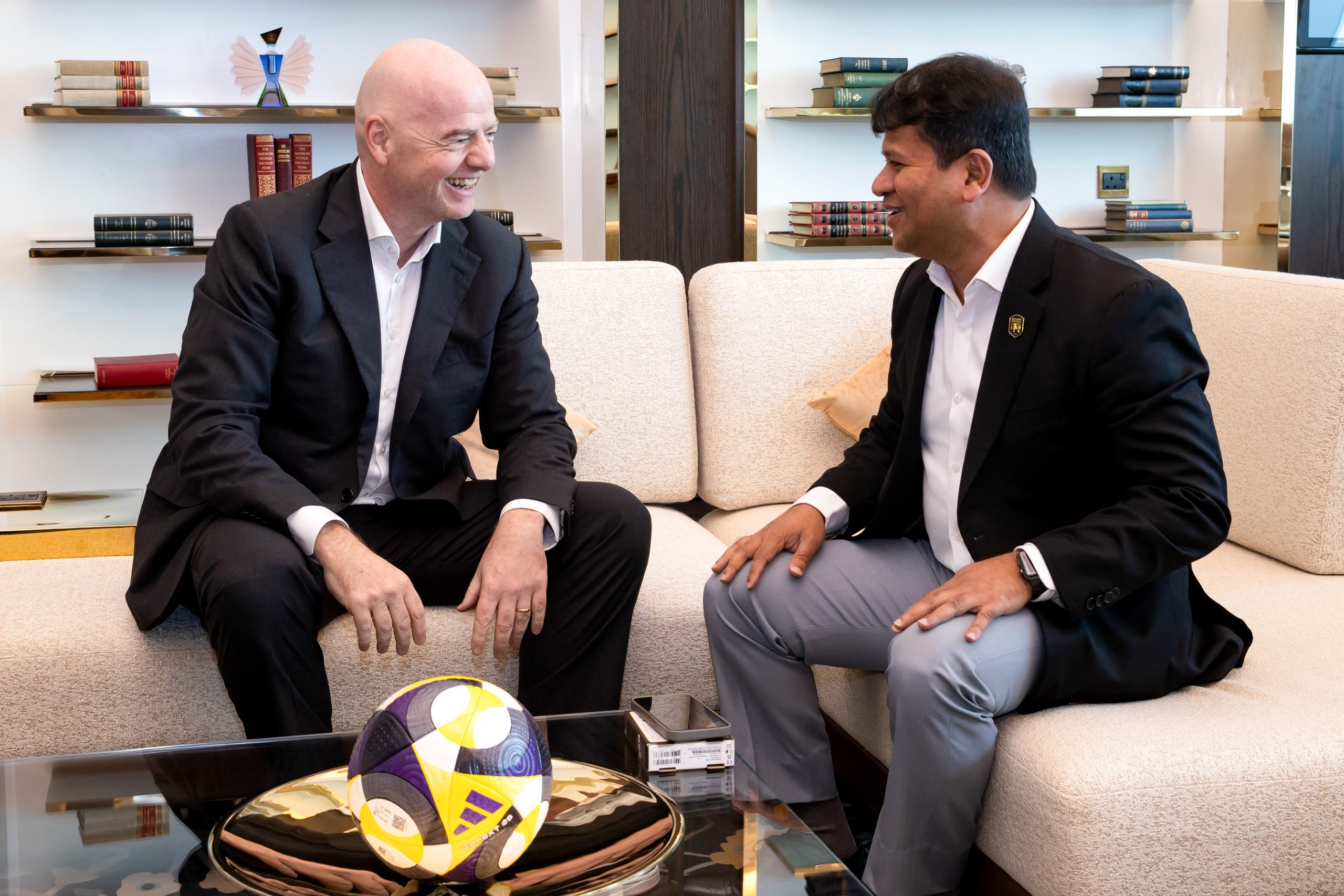
He stressed that the benefits extended beyond the football field. Sri Lankan officials involved in administration, technical operations, media, medical services and event management gained practical experience in organising matches to international standards.
The Racecourse Ground also received an important upgrade through assistance from FIFA’s Forward Programme. The renovation enabled the historic Colombo venue to host international football and created improved facilities for future events.
Umar said one of the most important achievements was bringing international football closer to Sri Lankan supporters. Young fans were able to watch national players compete against foreign opposition in their own city, helping to inspire a new generation.
He thanked FIFA and its President Gianni Infantino for supporting developing football nations.
According to Umar, the FIFA Series has left Sri Lanka with more than match results. It has provided international experience, stronger administrative capabilities, improved infrastructure and, most importantly, renewed belief in the future of Sri Lankan football.
Imesha Dulani stole the spotlight with a sensational unbeaten century as Sri Lanka Women chased down a formidable target of 177 to register a convincing six-wicket victory over Pakistan Women in the first T20I worked off at Dambulla international Stadium.
Pakistan looked set for victory after posting a competitive 176 for 7 in their 20 overs. Captain Muneeba Ali gave the innings early momentum with a fluent 42 off 24 balls, while Shawaal Zulfiqar anchored the innings superbly with a brilliant 63 from 41 deliveries, striking 10 fours and a six. Eman Naseer added a valuable 21, while Ayesha Zafar and Saira Jabeen played aggressive cameos in the closing overs to push Pakistan to an above-par total.
Sri Lanka’s bowlers shared the wickets, with Kavisha Dilhari leading the way with two dismissals. Chamudi Praboda, Sugandika Kumari and Kawya Kavindi chipped in with one wicket apiece, while disciplined fielding produced two crucial run-outs.
The chase belonged entirely to Dulani, who delivered the innings of the match. Displaying confidence, composure and a wide range of attacking strokes, she remained unbeaten on 101 from just 64 balls, smashing 17 boundaries and a six. Her innings combined elegance with controlled aggression, ensuring Sri Lanka stayed ahead of the required rate throughout the chase.
Captain Chamari Athapaththu provided the ideal platform with a sparkling 39 off 22 balls, adding 78 for the opening wicket before Nashra Sandhu broke the partnership. Although Sri Lanka lost wickets at regular intervals in the middle overs, Dulani remained firmly in control, rotating the strike effectively before accelerating when it mattered most.
Kavisha Dilhari contributed 11 valuable runs, while Nilakshika Silva remained unbeaten on nine as Sri Lanka reached 177 for 4 in 19 overs, sealing victory with six balls to spare.
Pakistan spinner Nashra Sandhu finished with two wickets, but she could do little to halt Dulani’s memorable knock.


BALL BLASTER 2026: SRI LANKA’S BIGGEST SCHOOL FOOTBALL TOURNAMENT RETURNS BIGGER THAN EVER

Jaswar Umar Hails FIFA Series as Turning Point for Sri Lankan Football

Dulani’s sparkling century powers Sri Lanka to thrilling victory

Sri Lanka Schools National Championship 2025: Super 8 Fixtures and Grouping

Sri Lanka’s Greatest Cricketers: Top Batters and Bowlers of All Time

2025 Schools Rugby Season Set to Thrill Fans with Knockout and League Action

FIFA World Cup 2026 Analysis | Group Stage & Round of 32 Predictions | Rexona Road to Glory EP 01

The Future of Sri Lankan Rugby | Pavithra Fernando Interview | Game Plan | Episode 1 Part II

RUGBY PRESIDENT PAVITHRA FERNANDO SPEAKS OUT! | Game Plan | Episode 01
-
 Football2 years ago
Sri Lanka Schools National Championship 2025: Super 8 Fixtures and Grouping
-
 Cricket2 years ago
Sri Lanka’s Greatest Cricketers: Top Batters and Bowlers of All Time
-
 News2 years ago
2025 Schools Rugby Season Set to Thrill Fans with Knockout and League Action
-
 Cricket1 year ago
Nuwan Thushara Shines as RCB Storms into IPL 2025 Final
-
 Live5 years ago
Live Broadcast of Syria vs Sri Lanka | AFC U23 Asian Championship Qualification
-

 News1 year ago
Major Shake-Up in Sports Governance: New 2025 Regulations Reform National Sports Bodies in Sri Lanka
-

 Football2 years ago
FFSL Rebrands Division-1 as ‘League-One’ with a Bold New Vision
-

 Cricket6 months ago
Chamindu Wickramasinghe’s bowling action under scrutiny?