
News
Oldest Sports in the World

Ever wondered which sport is the oldest in whole human history ? We dig deep and managed to the top 10 sports which are officially the oldest sports in the world.
#1. Wrestling
Just like prostitution is the oldest profession, Wrestling is widely considered the oldest sport in the world. Wrestling infects is the documented evidence unlike some of the other oldest sports listed on this page. Here are some details about the history of Wrestling.

- A “fragment of papyrus” which reportedly dates back between 100 and 200 A.D has the instructions about how to wrestle. The text is in the greek language and the word “pleckson” is used several times which is translated to “fight it out” in English. The document was discovered back in the 1800s in Egypt.
- That is not the only document evidence, there have been many dates back to different times but the one mentioned above is certainly the oldest ever found. So there is little doubt that Wresting is certainly the oldest sport known to man.
- It has evolved over the centuries of course and it was part of the Olympics as the first set of sports in the era between 800 to 1200 BC. P
- While Professional wrestling circuits were first introduced in Paris, France in the 1830s.
- Today Wrestling is not only an Olympic sport but a full-fledged professional career and widely regarded as one of the most popular and top sports in the world.
#2. Running & Long Jump

Running is the World’s most accessible sport and it always has been even now. Running universal human physical expression and it should not come as surprise that along with wrestling Running is the oldest sport. Here are some points about running as a sport.

- Running was the only sport in the first-ever recorded Olympics held in Athens back in 776 BCE.
- While competitive running was in modern times is recorded back to 1829 BCE.
- Running as a sport as many disciplines in the Olympics, with slightly different requirements such as marathon, sprint, long jumping and hurdling, etc
#3. Javelin & Discuss Throw

A very interesting sport that is still very popular in the modern Olympics, Javelin Throwing is a track and field sport and it dates back to the ancient Olympics in 708 bc. Here are details about the historic transition of the sport to modern Javelin throwing.
- A couple of disciplines likes distance and target throw were part of the sport in the artifacts found which dates back to ancient Olympics in the era of 708s.
- In the 1870s Poles used as Javelin now were introduced in Germany and Sweden and by the next decade, it became a yearly national event in Sweden and Finland. no wonder 50% of the medals awarded in modern Olympics to date went to athletes from Scandinavian countries like Denmark, Sweden, Finland, and Norway.
- In the 1890s some rule changes were introduced like limited run-ups before throwing instead of standing throws.
- It was introduced in the modern Olympics in 1906 while for women it was introduced in the 1932 Olympics.
#4. Polo

Polo is a team game which is played on horses. It’s a bit like Hockey the difference of course being played on horses back where both teams try to outscore each other by putting “small wooden ball” in the goal.
Polo origins date back to the peak of the Persian empire in central Asia it is believed that Persian emperors used to learn horse riding at a very early age and used to play a sport that would later go on to be known as Polo.
316 AD is the documented evidence about sport like Polo in the Persian empire. While the modern game with rules and regulations was developed in India during the time of the British empire and the first Polo club dates back to 1833 in India.
#5. Boxing

Boxing is a combat sport and one of the most popular combat sport in the world. It has a long and illustrious history in modern times. While historically speaking “fist fightïng” as a sport has evidence from 2nd and 3rd Millenium BC but the fist fighting with hand protection is believed to be in existence from 900 bc to 1500 bc. Romans also had Boxing sport with leather thong wrapped around the hands but in Roman-era boxing was more of a fight till death so strange to call it a sport.
While fist fighting as a sport with rules and regulations can be found in England with “bare-knuckle fighting” in 1681. Boxing’s first rules dates back to 1743 with introduction of 30 second count, no hitting while opponent is down etc.
But from 17th to 18th century fist fighting or boxing sort sport were widely considered illegitimate and there werent many rulings. Amature boxing was introduce in Olympics in 1908, that kind gave new life to boxing with weigh-division rules coming into play at the same time.
So with young boxers fighting in amateur events and Olympics, they would go down to become professional fighters later in their careers ultimately developing better skills of boxing helping to improve the standard. Now boxing is one of the most popular sports in the world.
#6. Gymnastic

Gymnastic is originated from ancient greek and at the beginning, it was a set of training methods deployed for military training but as a sport, its history is not much known from ancient times.
As far as modern Gymnastics is concerned it dates back to the late 18th century when two physical educators from Germany developed and exercise from boys using “apparatus” it would later go on to become a sporting event quickly spread across Europe and then the world.
The international federation for Gymnastic was established in 1891 while it was introduced as a sport with several events for both men and women in 1896.
#7. Football/Soccer

Football sort sports have been played since early centuries from 200 to 300 bc according to FIFA FIFA (The world governing body of football). In medieval times loads of games involving “Ball” were played around Europe and some of them were pretty much like football. A game called “mob football” was played in England in the 10th century but the number of players included was unlimited. Football sort sport was continued to be played around Europe and especially in England and that is where the modern rules/codes were formed when football was played in the schools in England.
The Sheffield FC is the oldest professional football club which was formed in 1857 and soon after that football modern rules were introduced and the first professional cup competition now known as FA Cup started.
#9. Hurling

Hurling has been played in Ireland for over 3000 years making it one of the oldest sport in the world. It is a team game which is played with a stick called “Hurley” and the ball “sliotar”. The objective is to score goals into the opposing goalposts with the use of the stick. Unlike some of the other sport listed here, Hurling has a documented history and it is very popular in Ireland.
#10. Field Hockey

A game pretty similar to field hockey can be traced back to ancient greek were some of the graphics discovered show paintings of people playing some sport with a curved stick/Horne and ball. The modern hockey rules were invented in England by the Middlesex cricket club in the last 19th century and it spread to British colonies In Australia, Africa, and the sub-continent. International hockey federations were established and hockey was included in the Olympics in 1908.

24 Schools, 15 Venues and Three National Trophies as Ball Blaster Enters Its Third Year
COLOMBO — Ball Blaster, Sri Lanka’s premier school football tournament, is set to return in 2026 with its biggest edition yet, organized by Aasgard Sports (Private) Limited in collaboration with the Sri Lanka Schools Football Association and the Ministry of Education.
Now entering its third year, Ball Blaster has grown from 2023 with 20 schools into one of the country’s largest youth football events. The 2025 edition featured 16 schools competing across four groups, drawing national broadcast attention through Sri Lankan Sports TV and PEO TV. For 2026, the tournament expands significantly, with 24 schools set to compete across 15 venues nationwide, in a season spanning six weeks and 84 matches.
A NEW FORMAT: THREE TROPHIES, THREE CHAMPIONS
The standout feature of Ball Blaster 2026 is a new three-tier trophy format. Schools will be drawn into four groups of six, playing a round-robin group stage before advancing into one of three parallel championships based on their group finish: the Cup Trophy for group winners, the Bowl Trophy for runners-up, and the Plate Trophy for second runners-up. The format ensures every participating school remains in contention for a national title deep into the tournament.
All three championships will reach their conclusion on the same finals weekend, with third-place playoffs and grand finals for the Cup, Bowl and Plate trophies all being played at Sugathadasa Stadium in Colombo.
“Ball Blaster has always been about giving young footballers a stage,” said a spokesperson for Aasgard Sports. “This year, we’re expanding that stage to every corner of the island, and making sure every school that takes part has something real to play for, right to the final whistle.”
BUILDING ON A STRONG 2025
Ball Blaster’s growth has been underpinned by strong sponsor support. The 2025 edition was backed by Lifebuoy as Title Sponsor, alongside Lemonade as Refreshing Partner and Sky Market Travels as Travelling Partner. Organizers say conversations are already underway with returning and new sponsors ahead of the 2026 season, as the tournament’s expanded scale — nationwide venues, a longer season and three separate finals — offers significantly greater visibility for partners.
BROADCAST AND COVERAGE
As in previous years, Ball Blaster 2026 will be broadcast live via Sri Lankan Sports TV and PEO Sports, with matches also available on YouTube and across Sri Lankan Sports TV’s digital platforms.
For sponsorship and partnership enquiries, contact: Pasindu Mihiranga Sri Lankan Sports TV | Aasgard Sports (Private) Limited 0726 85 18 18 marketing@srilankansportstv.com
www.srilankansportstv.com
Football Federation of Sri Lanka (FFSL) President Jaswar Umar has described the inaugural FIFA Series in Colombo as a major milestone for the country’s football development, saying the tournament has given Sri Lanka renewed confidence and a stronger connection with the international game.
Umar, who has been involved in efforts to strengthen Sri Lankan football administration and development, said hosting the tournament demonstrated that developing football nations could compete on the global stage when given meaningful opportunities.
The FIFA Series, held in Colombo in March 2024, brought Sri Lanka together with Bhutan, Papua New Guinea and the Central African Republic. The four participating nations represented three different confederations, giving Sri Lanka an unusual opportunity to face teams with different playing styles.
Sri Lanka completed its campaign unbeaten, drawing 0-0 against Papua New Guinea and defeating Bhutan 2-0. Umar said the matches provided valuable experience for the national team and helped players adapt to different forms of international competition.
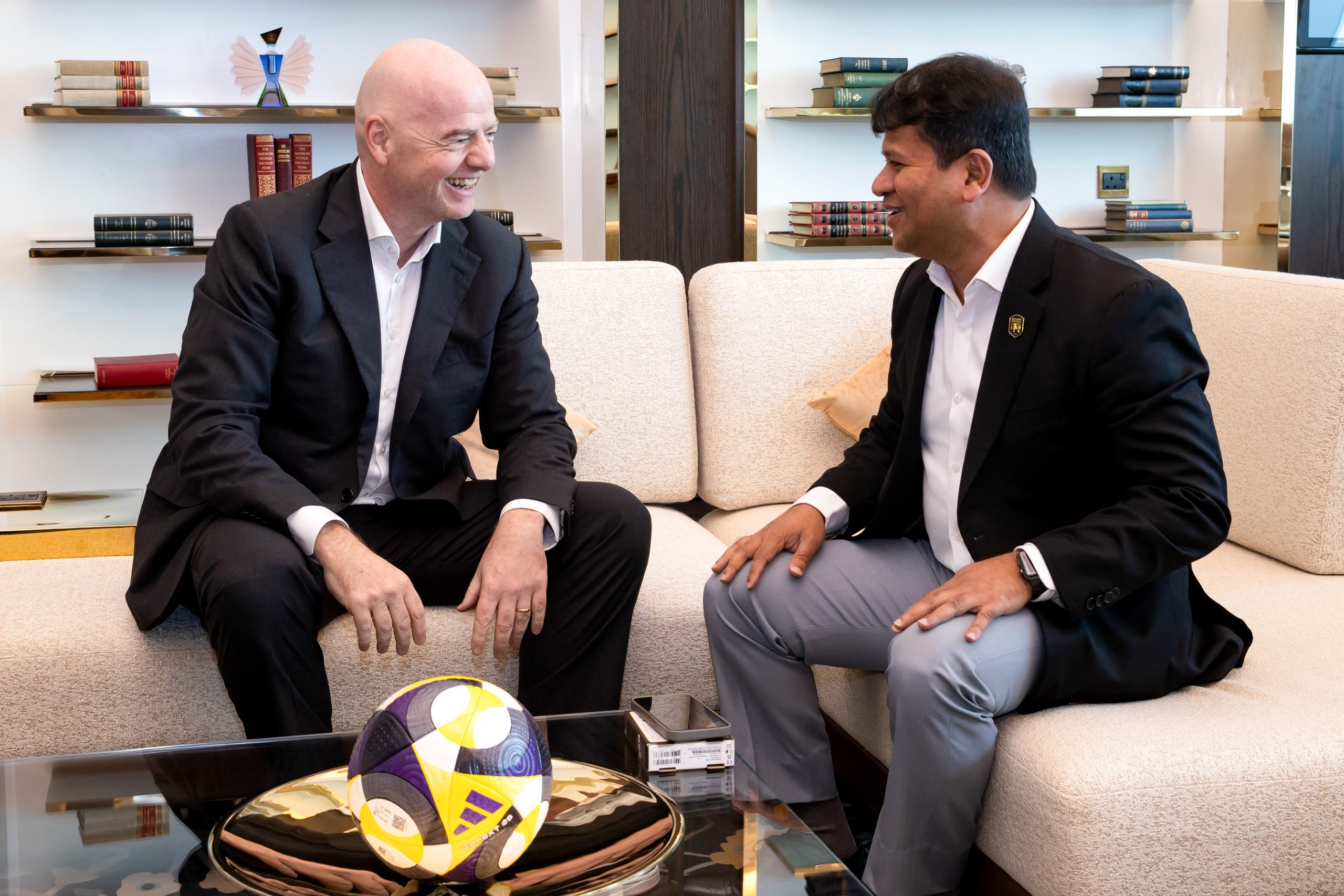
He stressed that the benefits extended beyond the football field. Sri Lankan officials involved in administration, technical operations, media, medical services and event management gained practical experience in organising matches to international standards.
The Racecourse Ground also received an important upgrade through assistance from FIFA’s Forward Programme. The renovation enabled the historic Colombo venue to host international football and created improved facilities for future events.
Umar said one of the most important achievements was bringing international football closer to Sri Lankan supporters. Young fans were able to watch national players compete against foreign opposition in their own city, helping to inspire a new generation.
He thanked FIFA and its President Gianni Infantino for supporting developing football nations.
According to Umar, the FIFA Series has left Sri Lanka with more than match results. It has provided international experience, stronger administrative capabilities, improved infrastructure and, most importantly, renewed belief in the future of Sri Lankan football.
Imesha Dulani stole the spotlight with a sensational unbeaten century as Sri Lanka Women chased down a formidable target of 177 to register a convincing six-wicket victory over Pakistan Women in the first T20I worked off at Dambulla international Stadium.
Pakistan looked set for victory after posting a competitive 176 for 7 in their 20 overs. Captain Muneeba Ali gave the innings early momentum with a fluent 42 off 24 balls, while Shawaal Zulfiqar anchored the innings superbly with a brilliant 63 from 41 deliveries, striking 10 fours and a six. Eman Naseer added a valuable 21, while Ayesha Zafar and Saira Jabeen played aggressive cameos in the closing overs to push Pakistan to an above-par total.
Sri Lanka’s bowlers shared the wickets, with Kavisha Dilhari leading the way with two dismissals. Chamudi Praboda, Sugandika Kumari and Kawya Kavindi chipped in with one wicket apiece, while disciplined fielding produced two crucial run-outs.
The chase belonged entirely to Dulani, who delivered the innings of the match. Displaying confidence, composure and a wide range of attacking strokes, she remained unbeaten on 101 from just 64 balls, smashing 17 boundaries and a six. Her innings combined elegance with controlled aggression, ensuring Sri Lanka stayed ahead of the required rate throughout the chase.
Captain Chamari Athapaththu provided the ideal platform with a sparkling 39 off 22 balls, adding 78 for the opening wicket before Nashra Sandhu broke the partnership. Although Sri Lanka lost wickets at regular intervals in the middle overs, Dulani remained firmly in control, rotating the strike effectively before accelerating when it mattered most.
Kavisha Dilhari contributed 11 valuable runs, while Nilakshika Silva remained unbeaten on nine as Sri Lanka reached 177 for 4 in 19 overs, sealing victory with six balls to spare.
Pakistan spinner Nashra Sandhu finished with two wickets, but she could do little to halt Dulani’s memorable knock.


BALL BLASTER 2026: SRI LANKA’S BIGGEST SCHOOL FOOTBALL TOURNAMENT RETURNS BIGGER THAN EVER

Jaswar Umar Hails FIFA Series as Turning Point for Sri Lankan Football

Dulani’s sparkling century powers Sri Lanka to thrilling victory

Sri Lanka Schools National Championship 2025: Super 8 Fixtures and Grouping

Sri Lanka’s Greatest Cricketers: Top Batters and Bowlers of All Time

2025 Schools Rugby Season Set to Thrill Fans with Knockout and League Action

FIFA World Cup 2026 Analysis | Group Stage & Round of 32 Predictions | Rexona Road to Glory EP 01

The Future of Sri Lankan Rugby | Pavithra Fernando Interview | Game Plan | Episode 1 Part II

RUGBY PRESIDENT PAVITHRA FERNANDO SPEAKS OUT! | Game Plan | Episode 01
-
 Football2 years ago
Sri Lanka Schools National Championship 2025: Super 8 Fixtures and Grouping
-
 Cricket2 years ago
Sri Lanka’s Greatest Cricketers: Top Batters and Bowlers of All Time
-
 News2 years ago
2025 Schools Rugby Season Set to Thrill Fans with Knockout and League Action
-

 Cricket1 year ago
Nuwan Thushara Shines as RCB Storms into IPL 2025 Final
-
 Live5 years ago
Live Broadcast of Syria vs Sri Lanka | AFC U23 Asian Championship Qualification
-

 News1 year ago
Major Shake-Up in Sports Governance: New 2025 Regulations Reform National Sports Bodies in Sri Lanka
-
 Football2 years ago
FFSL Rebrands Division-1 as ‘League-One’ with a Bold New Vision
-

 Cricket6 months ago
Chamindu Wickramasinghe’s bowling action under scrutiny?
You must be logged in to post a comment Login